Professor Tord Kjellstrom gave a lecture and Q&A about the effects of climate change on workers for the Nelson Science Society on Tuesday night.
Kjellstrom, director of the Health and Environment International Trustand visiting fellow at NMIT, spoke of the “extraordinary inequality” between hot, poor countries around the equator and rich, cold countries in Europe and North America in the coming decades as a result of climate change.
Countries in South East Asia and West Africa will lose billions of dollars in productivity and work capacity, while countries like Canada and Russia have calculated that their economies will actually benefit from the effects of climate change.
Kjellstrom provided the example of the Le Lai shoe factory in Haiphong, Vietnam. During the summer, workers stay two hours longer everyday to produce the same output. It’s so hot and humid they have to take more breaks.
“The trends are always going up,” he said.
In the upcoming UN Climate Change Conference in Paris, scientists and world leaders will make plans to limit the global temperature change to 2 degrees Celsius over the next 100 years.
The graph below shows four plans for the expected global temperature change. The top blue line is unsustainable and the bottom line is not currently feasible. Kjellstrom says we can expect the temperature to rise somewhere around the green and red lines in the middle of the graph.
Four plans to limit global temperature change. Most predict we will end up somewhere around the green and red estimates.
Kjellstrom added the expected life span of his two-year-old grandchild (yellow), and the successive generations. This child will almost certainly live to 2100, when the global average temperature is expected to be 2 degrees Celsius higher than it was in 1995.
“I imagine the sort of world he is going into,” Kjellstrom, who grew up in Sweden but has lived most of his life in New Zealand, said.
Kjellstrom and his research team have compared the temperature increases in places around the world and gauged the effects on working people in fields and factories.
Here in Nelson, with a booming fruit picking industry, the temperature has been increasing at a rate of 0.16 degrees Celsius every decade. It won’t make a huge difference in labor productivity.
Compare that to Singapore, where it is rising at a rate of 0.29 degrees every decade.
Or Istanbul, at 0.97 degrees.
Or Santiago de Queretaro, Mexico, where the temperature has risen at a rate of 1.29 degrees every decade since 1980. This is not a prediction, this is what has already happened.
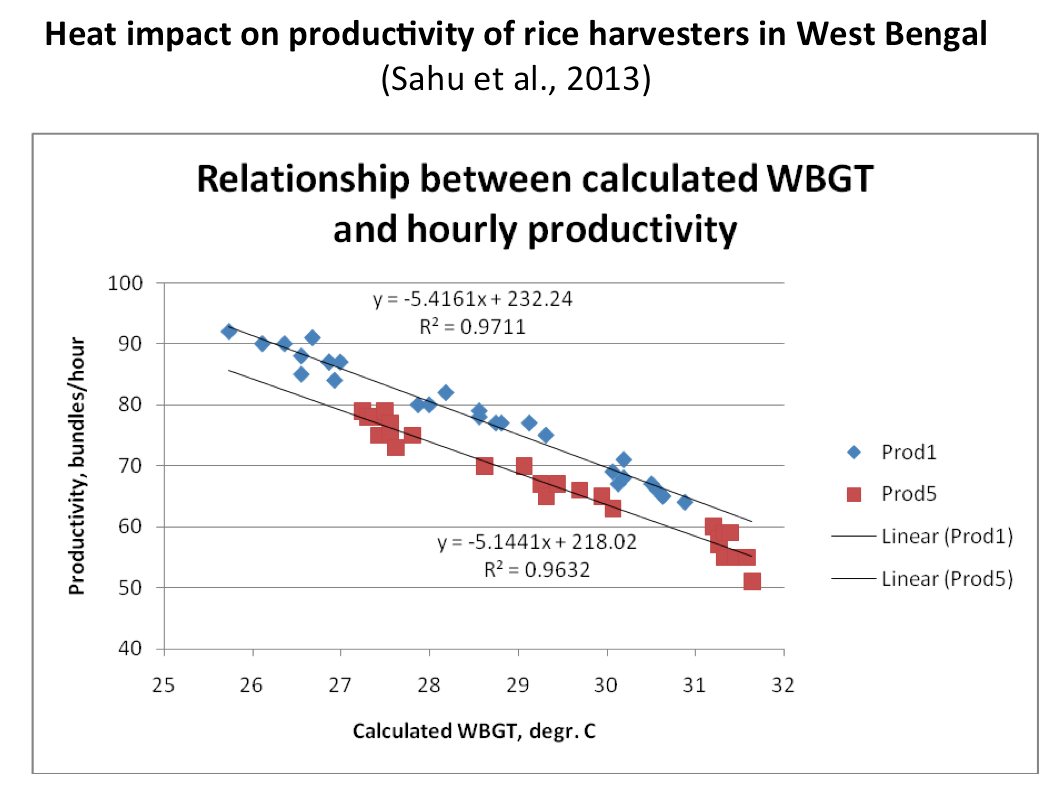
It is clear that as the temperature rises, productivity falls. Workers have to start earlier in the day, take more breaks, take naps during midday or, in some cases, work becomes impossible.
WBGT is a heat stress index created by the American Military. It takes into account temperature, humidity, wind and other environmental factors. As WBGT increases, productivity plummets.
With a wide disparity between hot, poor countries and cold, rich countries, scientists and economists predict mass migration, massive loss in labor productivity and mass fatality. Entire countries will become unlivable in coming centuries.
The Climate Vulnerability Monitor expects a global loss of $2.4 trillion (USD) in global labor productivity annually by 2030.
That’s a lot of people with no where to go. He says they might be resettled in the cold, safe climates of Siberia or Northern Canada.
“I hope you are educating this government,” a woman from the crowd says during the Q&A, alluding to the conservative Prime Minister John Key. Everyone laughed and one man quipped, “Is that possible?”
The discussion lasted longer than the lecture. I appear to be the youngest in the crowd of about 60 in the auditorium style classroom at the Nelson Marlborough Institute of Technology. Most of the attendees are the type of Kiwi mothers and grandmothers who wouldn’t allow you to refuse a cup of tea or coffee and homemade biscuits. Rumbles of mmm, mmm, mmm and head nods spread through the crowd when Professor Kjellstrom makes an especially poignant remark.
“Is there anyone here who doesn’t believe in climate change?” he asks the crowd. Just laughs.
One member said, “It’s not a belief system…We should not use the word belief.”
Unfortunately, many people don’t see it that way. I find it sad that we most certainly have the ability and technology to stop climate change, but capitalism is preventing progress. Too many corporations and lobbyists are simply making too much money from fossil fuels, agriculture and livestock. They like the status quo and aren’t willing to change.
Kjellstrom said with his age he has learned to be patient. He said it is difficult to find funding for research and even more difficult for people to believe your work if it is not published in a peer-reviewed journal. It’s clear this fight will take time, but by the time we take action, it might be too late.
P.S. I just watched Cowspiracy on Netflix. Holy shit. Mind blown. If you really want to be an environmentalist, stop consuming all animal products and go vegan.
I had no interest in drinking with the kids at the hostel on a Saturday night, so I set off into town with my backpack and camera, not knowing what to expect.
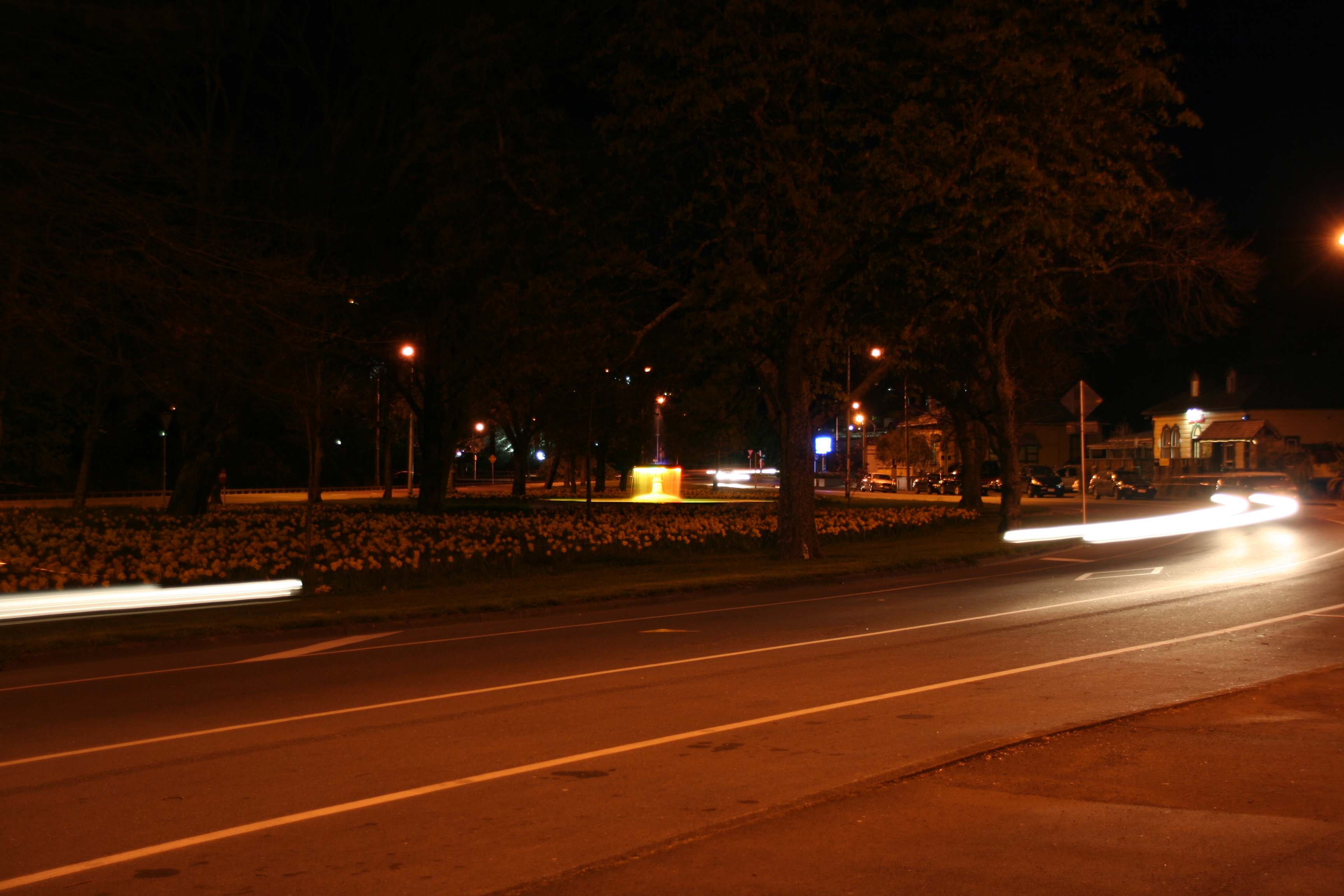
Invisible cars.
The city of Nelson was quiet at 9 pm. I heard live music and headed in that direction. All of the sudden I see hand painted signs, tents, a circle of camp chairs, raggedy people standing around wrapped in blankets and a guy playing Neil Young on his acoustic guitar.
“Hello!” one of the white-haired ladies called out. “We’re protesting the TPPA.”
After a momentary hesitation, I realize this is the place I need to be tonight.
I take a seat and ask the woman who greeted me, “So why are you against the TPPA? Gimme your spiel.”
She began to answer and I interrupted, “You don’t want to give up your sovereignty.”
“Yes, exactly,” she said.
I think some of the protesters thought I was homeless because everyone asked me where I am staying. Don’t worry, guys, I’m staying at a hostel and I’m not crazy. I’m from D.C. and I understand politics and I just want to talk to you all.
I was introduced to Graeme, the organizer for the event. On August 16, New Zealanders all over the country protested the Trans-Pacific Partnership Agreement. Nelson had a strong turnout of about 750, according to the NelsonMail. This Occupy Nelson protest was a continuation of those protests, to show that support is still strong.
Earlier in the day, several protesters dressed up in Kiwi — not Kiwifruit — masks with Uncle Sam whipping them into line while he led Prime Minister John key on a leash.
I must say, these Kiwis certainly earn extra points for enthusiasm and creativity.
They proceeded to mob their Member of Parliament, Nick Smith.
By the time I arrived, there were 12 protesters at the Occupy site drinking tea, having pumpkin soup, and dancing to the music. Roughly half of them camped out overnight.
The problem with the TPPA, Graeme explained, is that we don’t know what’s in the agreement. It is a secret document, and more importantly it is above the high courts of the undersigned nations. It would be above the Supreme Court of the United States of America and the Supreme Court of New Zealand. What?
If passed, it would cede power to the rich assholes who run the big asshole corporations that are raping the Earth. That’s not democracy.
With an ominous red and white striped flag hanging over the stage and the Uncle Sam imagery from earlier, it is obvious that these New Zealanders are largely protesting America. But Graeme said they like regular Americans like me.
I laid it out like this: There’s the American citizen, then there’s the American government, and then there are the large corporations who have the real power.
Just take a look at TARP, the Troubled Assets Relief Program, signed by President Bush in 2008. Matt Taibi of Rolling Stone, wrote in 2013, “the bailouts were pushed through Congress with a series of threats and promises that ranged from the merely ridiculous to the outright deceptive.”
Congress didn’t really have a choice. The reckless investment bankers who got us into this mess were now telling the elected representatives of the United States that they have to pass these bailouts, or else something very bad will happen.
This is the same issue with the TPPA. It’s not only encouraging this type of behavior, it is making it legal and unable to be stopped by the established courts and political structures in the twelve countries involved. It’s the age old problem of money overpowering politics.
One of the occupiers asked me if I was involved in any protests back home. I said all of the support today is behind Bernie Sanders. He is the chosen one. He will save the world. My generation is looking around and saying, Nah, I don’t like this. Let’s change it. Bernie has the answers and we have the votes.
Bernie speaks with passion. The middle class is dying, people working full-time shouldn’t be poor, healthcare is a fundamental right, income inequality is destroying the country, cut military spending and put it into education, let’s make college tuition free. He drives his point forward and he makes you think, Well, yeah, this is obvious why haven’t we always done this? I trust him to take us in the right direction.
Now watch a video from the Hillary campaign.
I was waiting for the ad to end and then I realized there is no ad. That’s how the Hillary campaign feels. It’s fake and forced. I cringe listening to Hillary. She has no passion and frankly, I don’t trust her. Bernie is genuine and Hillary is so very scripted and focus-grouped.
I told a protester, you want to know the difference between Bernie and Hillary? Look at their donors. Follow the money.
And don’t trust some bullshit blog for these numbers, go to OpenSecrets.
Hillary is the establishment candidate of banks and law firms. Money. Bernie is the candidate of the worker. Humans.
Bernie has refused to accept money from Super PACs and the average donor gives $31.30, according to campaign officials. People like me support Bernie. I’ve always donated my time to the Democrats — but I can’t do that if I’m in New Zealand — so I donated $10 to his campaign. It’s not much money, but if one million young people can give $5 or $10, that really adds up.
An all too common problem with American elections is that people think who ever raises the most money will win. While money is a huge advantage needed to buy advertisements and have a strong ground game to Get Out The Vote, it doesn’t decide the outcome. The only thing that matters is which candidate gets the most votes.
And fortunately, Bernie doesn’t need to spend money buying TV advertisements because young people — the group who we actually need to get to the polls — don’t watch TV, and if they do, they DVR and skip the commercials. C’mon, it’s 2015.
Young people use social media and the Internet. They watch Netflix. As The Guardian puts it, Bernie is the king of social media. Young people are advertising Bernie on their own. Every election now is a new normal. It’s constantly evolving with technology and enthusiasm.
Yeah, I preached the Gospel of Bernie to these TPPA protesters. I preached hard.
Events like this always attract unique people. The litmus test is their response to the question, “What do you do?”
I asked Jonny the routine question and he said, “I am a child of God.”
I raised an eyebrow. “No, seriously,” he assured me.
As a boy he was sent out to live in the wilderness with a shovel. He dug out rabbit holes with the shovel, killed the rabbits with the shovel, and cooked the rabbits on the shovel.
As a teenager, he relied on trapping possums, hunting, fishing and bartering with the bounty the land provided. He later realized that instead of bartering, it is more efficient to develop skills. Now in his thirties, he writes Children’s books that teach children to never underestimate their own power. He is one quarter Maori and a spiritual guide.
As he explained how he lives in balance with the world, I said, “It’s permaculture.”
“Yes,” he cocked his head and looked at me with a bit of surprise. “That’s a very powerful word.”
I told him I read about permaculture in A Greener Life, the book the English hippies left in the van they sold me. Jonny, of course, was familiar with it.
During my visit to Te Papa, the Museum of New Zealand in Wellington, I thought of permaculture when I was learning about the Maori lunar calendar. There is a natural cycle that they have used for generations. The moon tells us when to plant crops, when to hunt, when to fish and when to let the sea urchins and fish grow fat. It means adjusting human life to the natural order instead of making nature change for us.
He told me of a meeting of the Nelson Science Society when one of the presenters wrote two equations on the white board:
1+1=2 1+1=1
He said he came into the lecture hall and saw these two equations and thought, there’s one equation and one unification. Everything works together. He said if you show people a picture of a landscape with trees, lakes and mountains and ask what they see, most people might pick out a few of of the individual objects.
“I see life,” Jonny said.
Jonny is like Ono, they are enlightened. You can feel it as you talk to them. They are on a higher plane of spiritual existence. They aren’t bothered by the day to day troubles, they see the bigger picture in every aspect of life.
I left the Occupy Protest and walked back to the hostel through town. The bars were overflowing with chaos and cigarette smoke. No thanks.
I’m at a hostel for the first time in a long time and all the smiling young people are clustered in little groups speaking alien languages.
The soft, pink boys with fashionable haircuts are laughing with the girls who have nice butts. They aren’t like the French girl sleeping in her car with her greasy ponytail at the oceanside campsite at Owhira Bay. Here they are clean and polished and talking about going out tonight. I haven’t showered in three days and my beard is unruly. My face is sun and wind burned, tired and creased. I feel like I don’t belong. I’m exhausted. For the past month I have been driving, cooking, cleaning, and finding a place to park my van every night, all while taking the time to go on walks to admire the beautiful New Zealand landscapes and watch my bank account dwindle. (Don’t worry, Mom, I’m doing fine.) There’s so much to think and worry about. I don’t know if I have the energy for anything anymore.
I came to a hostel because I’m tired of fleeting human interactions lasting only a few hours until we drive on. I have no friends and no one to fuck and no one to love and no one to care about.
I’ve been in the South Island for five and a half hours and I feel defeated. If the roads were straight, the drive to Nelson would have been quick and painless. But this is New Zealand. They cut through mountains, narrowly, switching back and forth. The Kiwi drivers have been zooming around them for years and they cut corners and ride the lines like assholes while I stay in my lane like a sane person and take the steep turns at a reasonable pace.
Good views, though.Like a painting.
Twenty-eight-years-old and just cracked 415,000 kilometers, my van has plenty of oil and the thermostat is steady but I think she is wanting more coolant because she just started to give off puffs of white smoke as we head up a hill that lasts forever. I renewed her Warrant of Fitness last week and they said the engine was fine, I just had to replace a tire. Still, my stomach sinks and I start to sweat with an annoyed line of cars behind me. I just hope she isn’t going to eat more of my money.
Why do I think about it so much? Money. It rules our lives. Everything I do costs money. I can’t go anywhere or do anything without it. People work everyday of their lives to save it and never think they can pick it all up and travel because they need more.
I go back to my room and take a shower. I emerge feeling refreshed and there’s a group of eighteen-year-old Germans sitting in cheap plastic chairs smoking cigarettes and a tattooed French guy standing by them. I intrude on their circle.
“Hey guys, I’m [REDACTED].”
The French guy asks me where I’m from. I’m American.
“American! Texas?” he asks and I crack a smile and say, Nah, Virginia.
Suddenly the alien monsters turn into cuddly teddy bears and they start speaking my language and we are all the same.
I return to the kitchen to cook my chicken thighs and red kidney beans and everyone is full of life and excitement. I can barely squeeze around the island to grab a frying pan. Apparently it’s pizza night. Groups from every European country are spreading flower on the table, throwing down their dough and rolling it out. Plates and cutting boards covered in sliced capsicum, onion, sausage and peperoni occupy the tables. Someone plays “Stolen Dance” by Milky Chance on a portable speaker and the Italian guy sitting on the arm of a wooden end-chair starts to fist pump.
Now I’m writing these words on the patio outside of my dorm and suddenly a familiar scent fills the air. I sniff and turn my head. The lounging Germans say, “You want a joint?”
Yes, please.
I’m the foreigner among friends from Berlin so they ask me questions about America and we talk about international news media and Merkel, Obama and Putin. They are fascinated by American news from Vice.com. Especially a story about rednecks tricking out diesel trucks to emit huge clouds of black smoke at unsuspecting victims.
“I hope they are just stories,” he says.
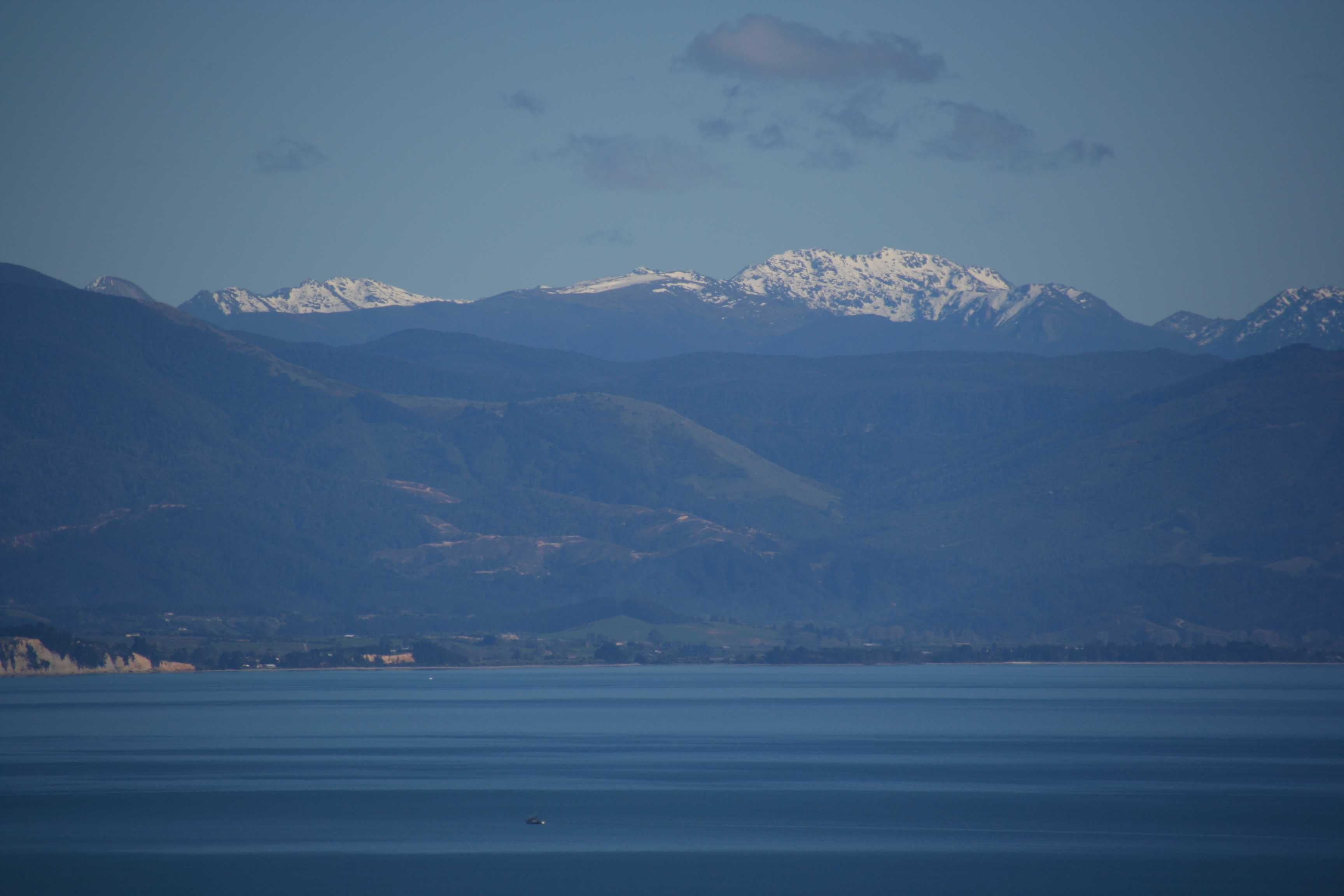
Coming to a hostel was a good idea. Maybe I’ll stay here and work for accommodation while I find a job. Or maybe I’ll leave tomorrow. It’s all good. In the mean time, I can relax and enjoy the town and the people. I’ll take a walk to the “geographical center” of New Zealand and admire the bay and the far away mountain range with peaks reaching above the snow line. The world isn’t such a scary place after all.
It’s not really the center, but that doesn’t bother the Kiwis.They make it precise.The town of Nelson with The Twins, Winter Peak and Mount Arthur on the distance.Devil River Peak and the Anatoki Range.
I woke up with a busted lip in a bed full of puke and a reminder that I’m not Hemingway.
The Department of Conservation campsite at Manakau, about 80 kilometers north of Wellington, is the best I’ve seen so far. It’s a basic campsite with a large pavilion with benches on the perimeter and a fire pit in the center. I arrived alone and immediately set out to gather firewood.
Fire.
By the time I came back with a heaping bundle on my shoulders, Jeff and Marianne from France arrived. They spent the past year in the South Island and took the ferry north that morning. I’m planning on taking the boat south in a few days so I was glad to have an opportunity to pick their brains.
They were, however, quite reserved and boring. That’s when Benji and Bin arrived to save the night.
Benji is a tall man from Singapore who sits up straight and clears his throat as he talks in his slow, deep voice. Bin is a smaller guy from China with a big smile. They both speak very fluent English. I asked them how they learned.
World of Warcraft,” Benji says. “Where’s the beacon? Ok, I know what that means. Attack the centaur. Got it. Capture the objective. All right.”
They were endlessly funny and loved to laugh. They brought a few leftover beers and I was drinking whiskey.
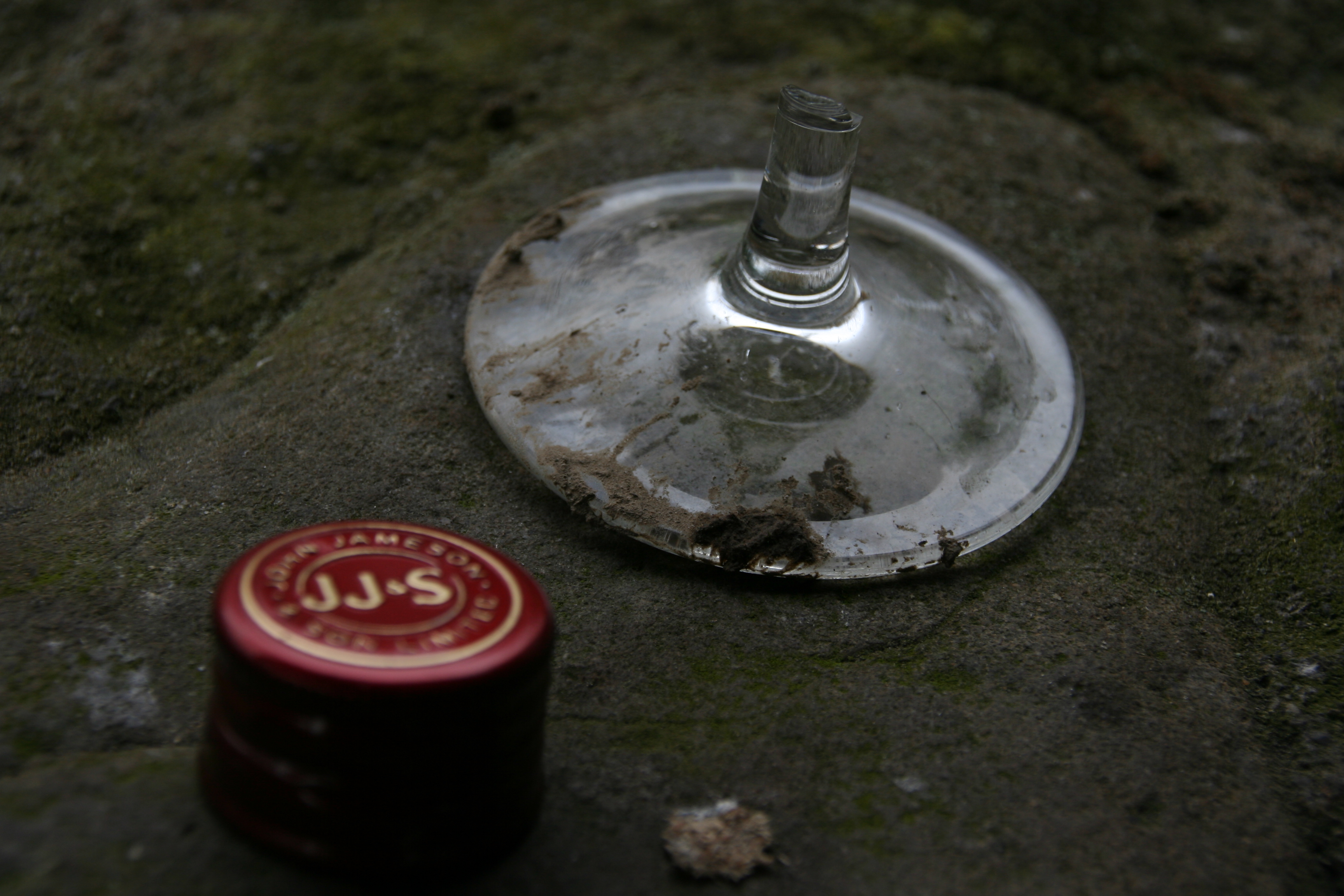
I haven’t been properly drunk since I arrived in New Zealand so I stopped off at Super Liquor for a bottle of Jameson. I decided to ignore the fact that my body does not handle liquor well and I have no tolerance. I also have a history of aggressive behavior and losing control of my body when I drink the poison. But I wanted to experiment and see what would happen.
We sat around the fire as Benji told me advice on backpacking in South East Asia while Bin and Marianne talked on the other side of the pavilion.
South East Asia is the backpackers’ dream,” he said.
He told me about Vietnam, Cambodia, Thailand and he said to buy a second-hand motor bike. They can go for as low as $300 and it will come with a registration number, which may or may not be legit. Just make sure the horn works. No one uses turn signals, they just lay on the horn to let you know they are coming up behind you.
I was a few glasses of whiskey deep and I poured some for my new friends. I looked down at the liter bottle and saw it was nearly empty.
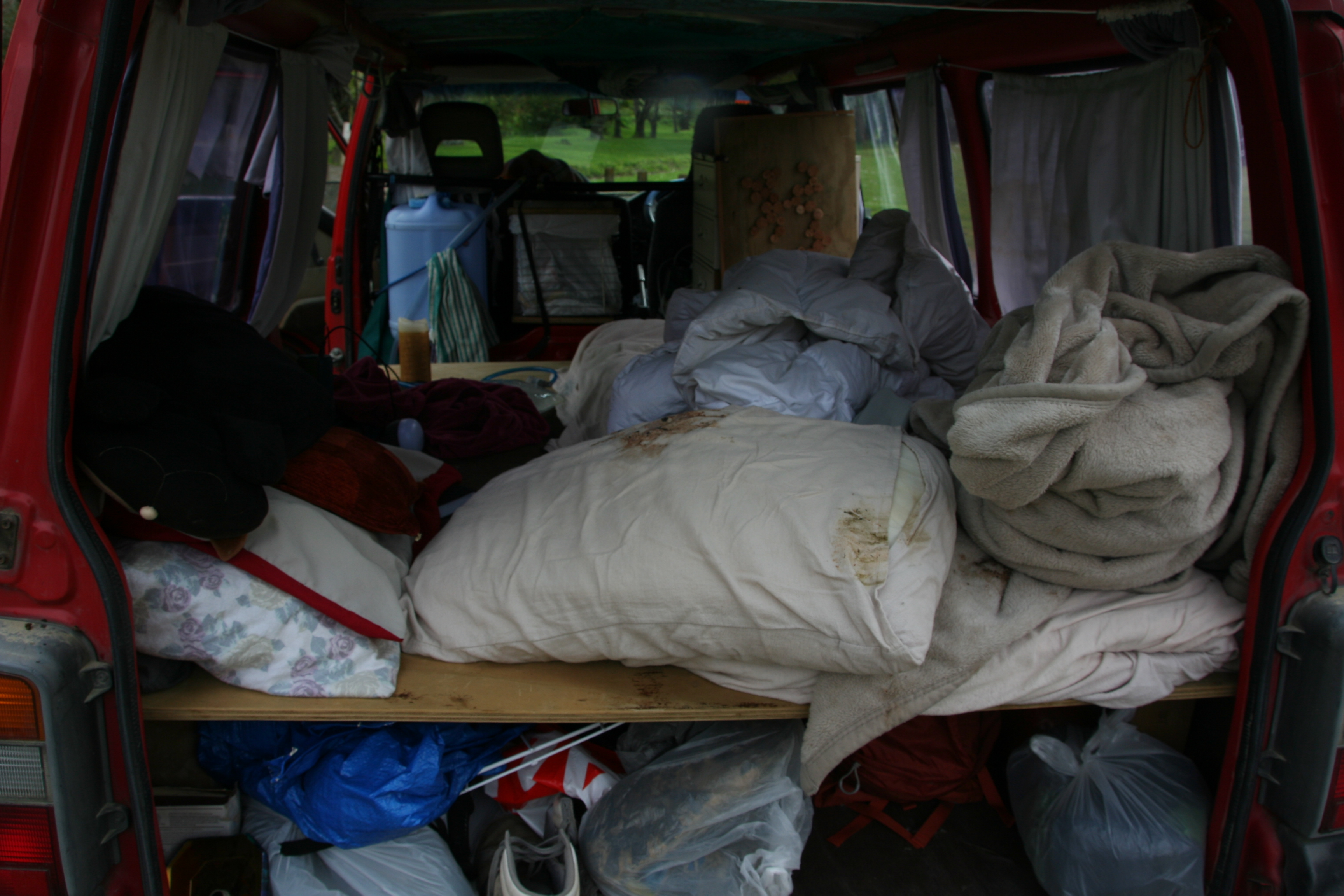
The next thing I know, I’m on the mattress in my van and I manage to open up the back door just in time to spew pure bile. There are chunks of puke scattered about the car and my feet are wet. I think someone might have punched me in the mouth because there’s dried blood under my nose and my lip is swollen. I can’t find my glasses.
Good work, [REDACTED].It was a great night until I blacked out. When I woke up at 11, everyone was gone. It will remain a mystery what happened that night.
I spent the afternoon wandering around looking for my glasses. Oh, nice, all 20 liters of water was poured out. And my box of pots, pans and cutlery was left out in the rain and is covered in mud. What the fuck happened.
That about sums it up.
I sat on the wall of the pavilion, still quite drunk, and ate a can of chocolate flavored creamed rice. I held the can in my hand with one bite left and just looked around and thought about what I’m doing with my life. Then I looked at my hands, which didn’t feel like they were part of my body, and broke the silence.
At least I have all my fingers.”
I laughed.
It’s better to have one of these nights at a campsite in the middle of nowhere with people I’ll never see again than in a dangerous city where I would have woken up in a jail cell. It’s a good wakeup call to remind me of my vulnerabilities and weaknesses.
Traveling alone can be dangerous but it also has made me very resilient. I have to be. I only have myself to depend on. So don’t do stupid shit. Stay smart and just smoke weed next time, dummy.
They are eating vacuum-sealed, dehydrated Fettuccine Alfredo flown in from California, sitting on folding chairs outside of their rent-a-van covered in a tiger mural. They are still hungry when they join me on my yoga mat. I’m slicing onions, garlic and cabbage with shoulder bacon waiting for a hot skillet by candlelight with my iPod on shuffle.
Americans. Fresh off the plane. Always in a rush.
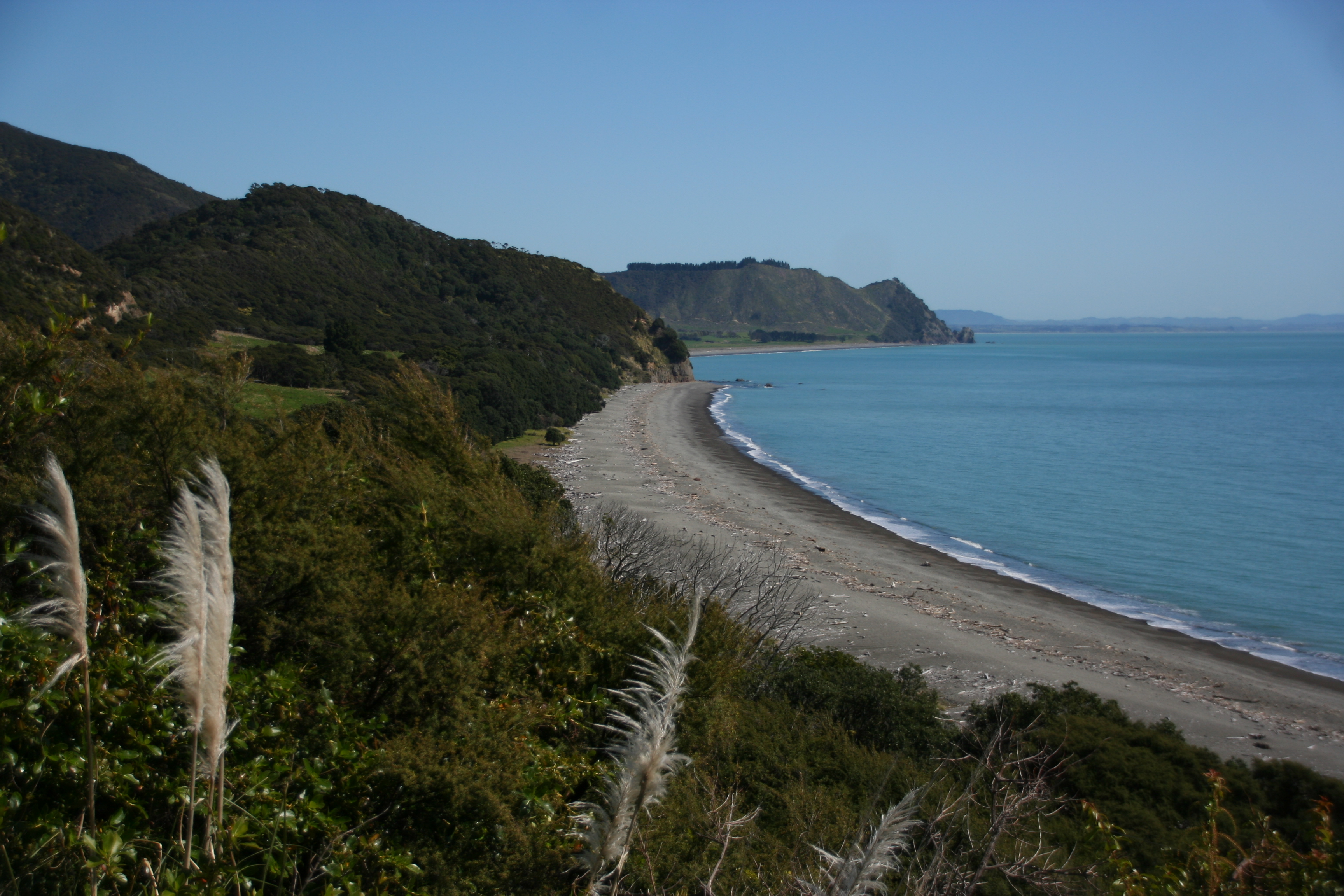
We first saw each other at a scenic cove overlooking the eternal meeting place of blue-green water, forest-covered cliffs and smooth-stone beaches. We greeted each other and kept driving. I start down the unsealed road to the East Cape, the most easterly point in New Zealand and home of the most easterly lighthouse in the world, when I see their van behind mine. Awesome, I’ll have some cool people to hang out with tonight, I think to myself.
Isolated land and sea.
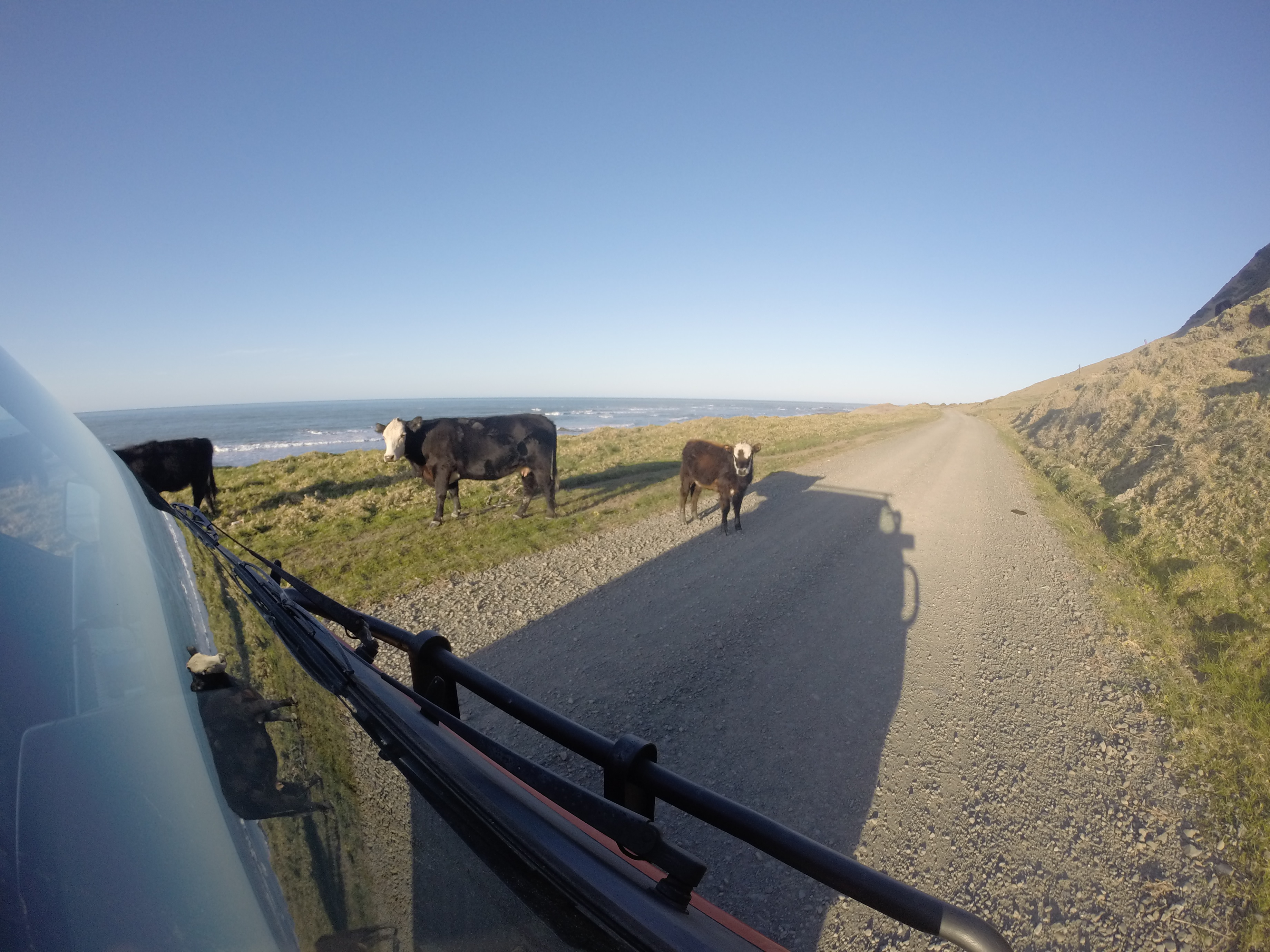
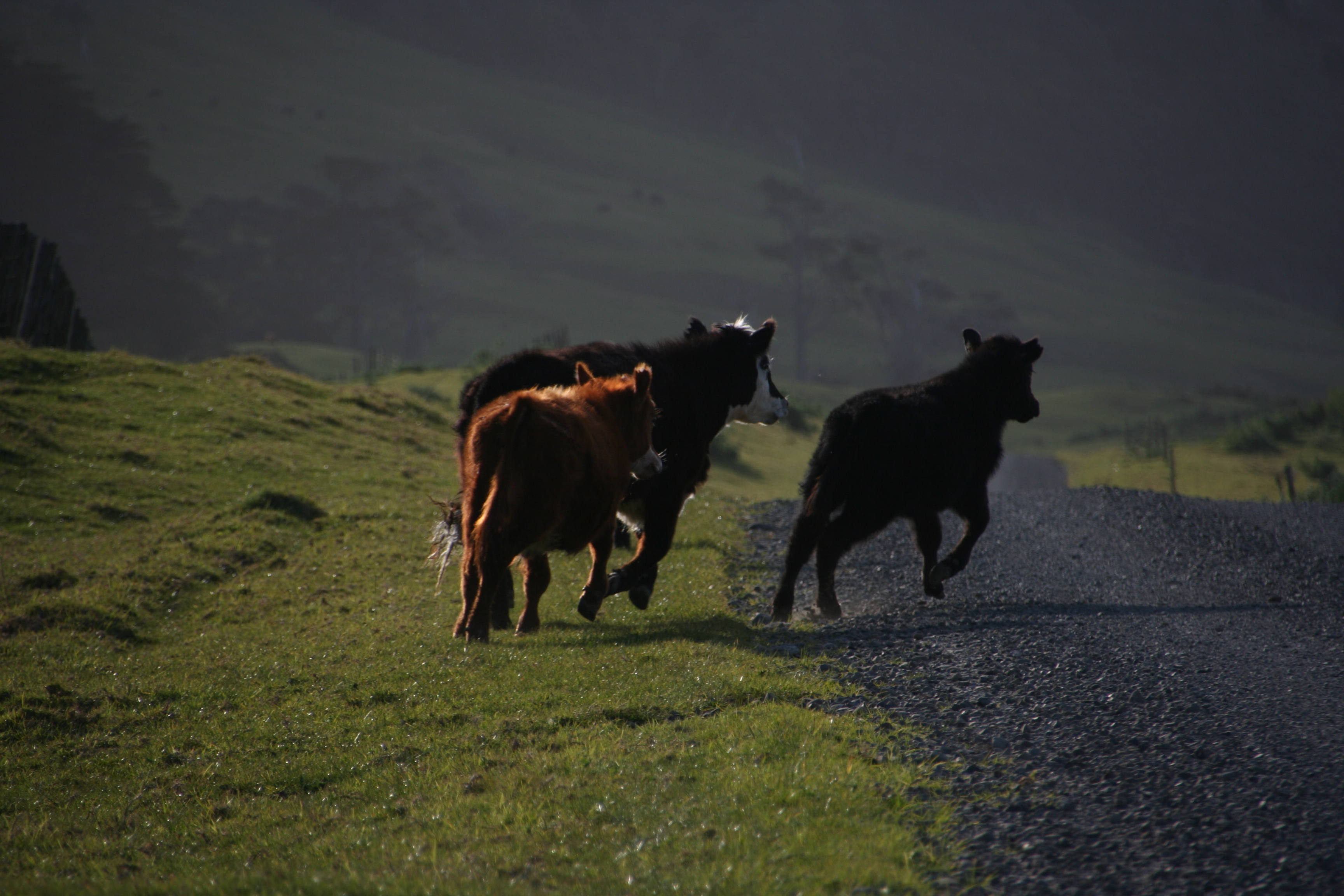
The drive is filled with cows and calves grazing unfenced on both sides of the gravel road. I have to stop to encourage the little ones to get out of the way.
You’re very cute. Now please move.
I see the hills reflect off of a still pond and I have to pull over to take some pictures. Their van stops next to me and he says,
“Are you looking for the same campground we’re looking for?”
I tell him I’m going to the lighthouse. I’ll see you there?
I didn’t know about a campground, I just wanted to check out the lighthouse to see if I could camp there for easy access to sunrise. Unfortunately, it is private land so I told them I plan on walking to the top tomorrow morning for sunrise. They agreed with my plan so we drove the slow, scenic six kilometers back to the campground, which was just a paddock with a spigot and an outhouse.
I’m excited to meet them and they want to learn about me. Britney and Tim lived across the hall at the University of California, Santa Barbara. They were both planning on traveling to New Zealand and when they met each other, they thought it would make sense to split the costs and go together. They are sleeping in a van about the same size as mine and they aren’t having sex. Weird.
Tim has long California hair and he lives two minutes from the beach. He is studying engineering and he works for some technology company. I assume he is well paid because he is able to take a three-week holiday to New Zealand.
Britney is graduated and is now working at REI, which explains why she brought along the backpacking meals-in-a-bag and why she is going on about her “Campsuds” when I say I’m going to wash my dishes.
After sitting and talking over the candle, we part ways and I fall asleep early to prepare for the next day. They said they would join me for sunrise at the lighthouse.
I woke at 5 am, brushed my teeth and flashed my lights at their van. No response. The lovely young Czech couple next to us shows signs of life. I give a double honk as I leave the campground, hoping Britney and Tim won’t be far behind.
I drive faster than I usually would on a gravel road with cows, calves, sheep, lambs and horses grazing unfenced in the dark. But I can’t wait to lie down in the grass with my camera on my tiny, flexible tripod to take a long exposure of the purple hues of early dawn.
The first picture of the day.
The Czech man crests the hill with his GoPro recording every second. They don’t speak much English but we don’t need to speak much to share such a special and beautiful moment. We are at the edge of the world witnessing the first sunrise together.
While the boyfriend is on the other side of the lighthouse taking pictures, I ask her where they are from and how she likes New Zealand.
She says they wanted to get away and travel and see beautiful places, and she was surprisingly eloquent with her limited English. I wish I knew more languages so I could have a full conversation with people from all over the world.
Then it was time for them to leave. They said Goodbye and then I said Goodbye. They were very happy and polite and not like the Americans.
Britney and Tim never made it to the lighthouse. By the time I returned to the campsite, they were gone.
They were probably driving all day. Meanwhile, I had a relaxing day of preparation and adventure. I cooked bacon, eggs and toast with blueberry jam over two cups of coffee, waxed my leather boots, sharpened my hand-forged knife gifted from my step-mother, mended holes in my merino wool underwear and socks, and packed my bag for a long walk.
I set off toward the paddocks and forests away from the coast, and as I’m walking out of the campsite, the farmer drives in. He kills his engine and motions for me to come around to the driver’s side.
“Kia Ora,” he says.
“Kia Ora,” I reply.
He tells me his name is Len and I tell him my name is [REDACTED].
Chill.
“Kia Ora, [REDACTED],” he says as we shake hands. His are callused, hard and dry.
“Nice to meet you,” I reply.
I ask him if he lives out here, Yup, the homestead is down by the lighthouse. I say it’s beautiful and isolated.
“Very isolated. My neighbor is just down the road, about four k’s,” Len says.
What a life.Epic sheep.
He says I look like a keen photographer, and I do with a full backpack and camera slung from my shoulder. I say I’m headed out for a walk and I’m wondering if this is all private land and if he minds if I wander around.
Without hesitation he tells me it’s fine.
I assure him I will shut all the gates behind me but he doesn’t seem to care at all at the thought of some random tourist tramping through his land. I’ve realized the importance of having a camera in hand. You can go anywhere if people see that you are just a photographer. As I walk away, though, I’m a little surprised that he didn’t tell me where his bulls are. I know they are out there so I’ll have to tread lightly.
He heads down the road a bit to shift his springer mob, the cows that are calving soon – and the only herd that are actually fenced in – and I open a gate and close it behind me and walk on his tyre tracks.
Len setting up his temporary fences.
There are paddocks with wire-less fence posts on either side of the road. On one side, the paddocks end at the beach, and on the other, they end at pine forests and native bush.
I follow his track to the edge of the forest and jump in. The pine trees are planted in neat rows, like every pine forest in New Zealand, and this helps me to not get lost. Where the pines end, the native bush takes over and I’m overwhelmed by its thickness. There is a bloated, decomposing cow in a ravine. I realize if I keep going forward I will get lost in the dense forest or I’ll fall or something bad will happen and I’ll end up like the cow so I turn back. I decide to walk along the road but then I see a logging track and decide that would be perfect. This is obviously not Len’s land, but he said I could go anywhere and I doubt there is anyone out here right now.
I think this means, Do Not Enter.
I walk down the path and practice my stealth skills so I can sneak up and capture birds with my time traveling device. It is futile. The birds have been evolving for thousands, or millions, of years and they fly away before I have time to draw and shoot. But my stealth skills still work on humans.
After walking as silently as possible for about 90 minutes, I turn a corner up a hill and see a small all-terrain-vehicle with three people standing around with coffee and smokes. They think they are alone out here so I don’t want to frighten them. I walk much closer than I expect before they notice me. I say, Hello. The Maori man facing away from me jumps. I say Kia Ora, I’m sorry, I’m just going for a walk. The man on the side of the vehicle is rolling a thin cigarette and asks me where I came from. Uhh, the end of the road, I’m staying at the campsite, I tell them. This is a very isolated area and they don’t understand how I made it up here on foot.
He says I’m not allowed to be up here, “We don’t give a shit, but the site manager would.”
He says there is a wild bull out here somewhere and I should be careful. I tell them Len said I could go anywhere and they all laugh.
I decided my best course of action is to head back the way I came so I don’t get caught here in the dark of night where I’m not allowed to be with a wild bull lurking.
I’m extra careful to listen for oncoming trucks and I look for places I can jump to stay out of sight. But I’m alone.
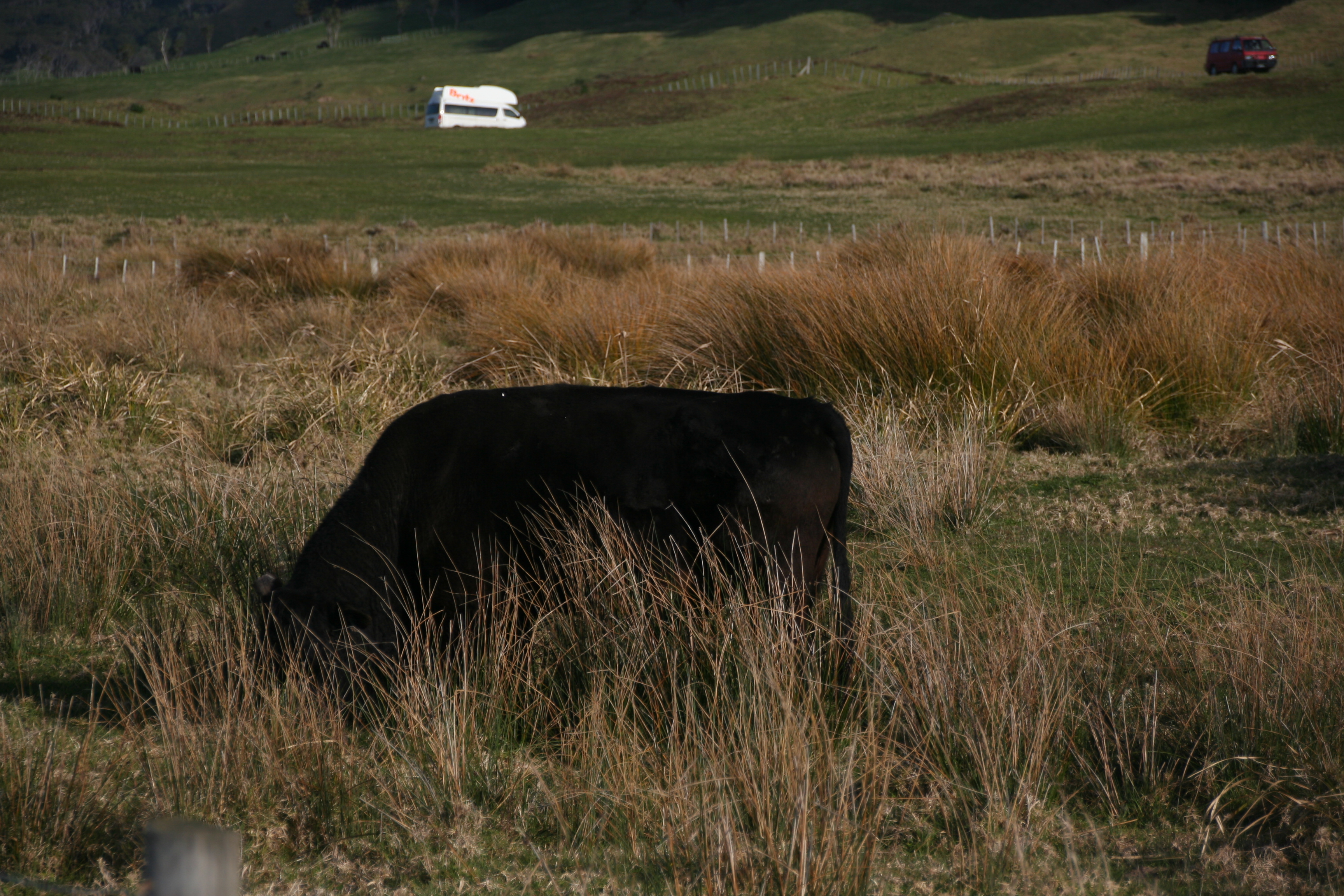
I make it back to the road and walk into the unfenced paddock and head toward the beach. A small group of cows and calves run away from me and I see a big black cow with its head down by the boundary fence.
Human! Run!
I sneak behind the big cow expecting it to hear me or sense me in the way that only animals can but it keeps its head down in the grass.
It looks… big.
I make it to the boundary fence and – by force of habit from working on Digger’s farm – I check it for electricity with a blade of grass. Of course there’s no power so I straddle the wire fence up to my crotch and step over. I walk in front of the big cow, now on the other side of the fence, and it finally acknowledges me.
It lifts its head. It is broad and heavy and powerful. His body is a mass of muscle and I realize, Holy Shit, I just walked a few meters behind a bull. I’m either really lucky or really stupid or this bull was just really hungry.
Menacing.
Cows can be controlled and guided while bulls are unpredictable. They don’t care how confident you are, they will charge you and pin you against a fence without thinking twice. On my first day milking cows at Rian’s farm one of his monstrous bulls hulked through the shed, after the girls were milked, with the swagger of Gregor Clegane. They are terrifying.
As I’m getting over how lucky I am, I see a self-contained Britz caravan trying to find the perfect spot to park for the night.
A new friend appears in the distance.
When I return to the campsite, I approach them. They are from Switzerland, on a two-month holiday.
I love the Swiss. They take their holiday seriously. When I was a waiter at the Overlander’s Steakhouse in Alice Springs – the real “Outback Steakhouse” – we had to place flags on every table to show the assortment of nationalities. Every night we had at least one table with the square red flag with white cross. They travel often and travel well. They don’t fly to the other side of the world for a measly fortnight.
Unlike the budget travelers I meet, who are usually a year or two or three younger than me, this efficient couple went for the camper with room enough to stand, cook, clean and have wild sex. He hasn’t shaved in four days and his English is more practiced than that of his wife.
She says with a hard accent that their car locks automatically and they have been locked out before so if it happens again they will come sleep in my van. We all laugh with the joy of meeting strangers in a strange land.
We tell each other how long we are here, the second mandatory question among travelers. I say two months is a good chunk of time, they aren’t in a rush and they can see most of the country without driving for seven hours a day. He says, Wow, a year. He says I have the best way to live. Work and little, travel a lot. He’s right.
There are difficulties, however, like finding a balance between going on adventures with wild animals, wild humans and wild landscapes and sitting down at my laptop somewhere with power and Internet to write about said adventures.
And what book should I read next?
When the Swiss couple leaves the next morning, we share a happy, hearty wave. I love the Swiss.
After another relaxing morning of seaside breakfast and yoga, I leave the East Cape and think about Britney and Tim.
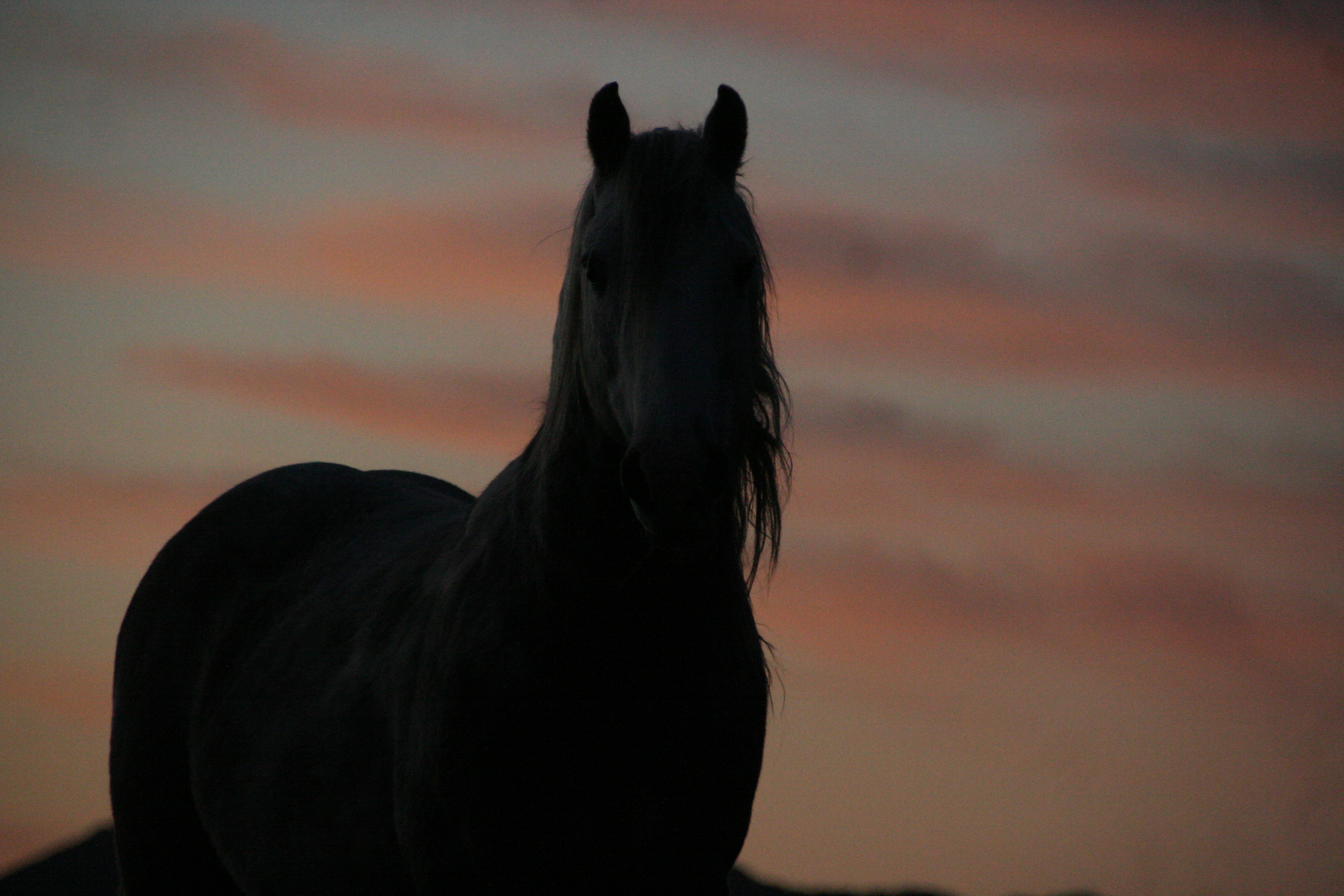
They didn’t see the first sunrise and they didn’t meet Len and they didn’t trespass through crown forest and sneak behind a bull or see the sunrise the next morning with magical horses grazing through the campground beneath the magical sky. I can’t blame them, they don’t know any better. I’m on a completely different schedule than them. I can afford to spend two nights on the Cape and then spend three nights at a motor park in Gisborne to wash my body and my clothes and renew the Warrant of Fitness for my van and buy contact solution and thread and darning wool.
New Zealand, you are amazing.
Len is the luckiest man in the world. He owns the most easterly land in New Zealand. He spends his days with his sheep, cows and horses. His animals are happy — they graze freely and babies stay with their mums — and he is happy. He can go fishing or collect shellfish from the bountiful sea. And he can stop to talk to travelers who come to camp on his land.
I’m glad I decided to tour Eastland instead of heading straight to Gisborne to sit in the library and write all day. Adventure comes first. Blog comes second. You gotta have priorities in life.










 stories from a drifter