Meet the Crazies

I never expected to encounter religious zealots or political conservatives in Australia and New Zealand. I thought they could only be found in the wilds of America. But somehow they always manage to find me.

[REDACTED] and I weren’t prepared for the cold and wet of the Adelaide hills. We had been living in the desert for months, where the perpetual dry heat makes life easy. We sought refuge at a holiday park to dry our clothes and gear. I made the short walk to the facilities to put in a load of laundry.

“Good morning! Where are you from?” a middle-aged woman immediately asks me, as if she has been waiting for someone to talk to.

I say the States and she says that’s amazing. She spent time with some ranchers in Oklahoma and loved it. I try to shake her off and get back to my washing, but she appears to be brainwashed or maybe she is a robot because her wide eyes seem blank and her smile is way too big.

Yeah, I love America,” she continues, deadpan. “The only problem is that the military is controlled by the devil.”

The crazy inside of her is no longer able to contain itself and I take that as my invitation to stop giving her my time. I tell her to have a great day as I walk back to the site with a great story to tell [REDACTED].

Then there was the old man in the Auckland CBD who found me on a cold Monday morning. It was my third day in New Zealand and I was sitting on a bench smoking a rollie and drinking a flat white between opening a bank account, registering for a tax number and applying for my driver’s license.

“Mind if I join you?” he asks.

I always welcome a random conversation, so I invite him to take a seat. He hears my accent and tells me I must be an American. He says he’s a born again Christian. I get really excited and tell him I’ve studied you, what do you have to say?

I have something very bad to tell you about America,” he tells me, grimly.

Great! Lay it on me. I realize he isn’t the type of person to be straightforward as he begins his exposition. He says in the New Testament, there is a story of the sign of the devil, 666, marked on the right hand of sinners. I finish my cigarette and become impatient. He produces a small copy of the New Testament full of dog-eared pages and annotations and tells me to read the line he is referring to. I finish my coffee. Yeah, that’s great, man. What is this terrible thing you have to say about America?

He reaches into his coat pocket again and gives me a printed off article about Obamacare. It’s from some religious blog and it says as part of Obamacare, all Americans will be required to have a tiny microchip implanted in their right hand. And there you have it, folks, certified proof that Obama is the devil. But he’s not done yet. He tells me Obama is a Muslim at heart and there it is again, my queue to leave.

Looking back on these interactions, it would have been much more fun and interesting if I egged them on agreed with them. I should have taken it further, donned my tin foil hat and thought up some ridiculous conspiracy theory that would make them uncomfortable.

Now I’m in a rural farming town in New Zealand where Christian Farmers don’t pay any taxes and racism toward the Māori, Chinese and Indians is casual. And conservatism is king. Digger’s Father stopped by the farm yesterday morning and we had a little chat.

So, [REDACTED], who do you have for President?” the typical American question.

The first thing I have to say is how the Republican race is a reality show with Donald Trump fear-mongering to get the support of angry old white people. Then I say I’m not a big fan of Hillary, she is too establishment and too boring. I don’t trust her. I’m a big supporter of Bernie Sanders. I’ve been a fan of his for a while now but I never expected him to blow up like this. He is the first politician I’ve ever seen who actually tells the truth and focuses on people, not money.

We talk about this for a bit and he asks me what I want to do when I go back to the states. I tell him I want to be a journalist. I want to talk to people and ask questions and write. That’s the dream, for now.

He says all of the journalists here in New Zealand and way too far to the left. It takes me back to the days of Sarah Palin repeating the words “lame-stream media” on Fox News. I nod and think about how I’ve fallen in love with Susie Fergusen, host of Radio NZ’s Morning Report, and the way she ruthlessly attacks politicians and speaks truth to power. I don’t think of her as liberal. I think of her as trustworthy.

This is the way I see it: It is the job of the journalist to seek out the truth. If the majority of journalism is “liberal,” does that mean that journalists have a liberal bias or does it mean that the truth has a liberal bias?

Next we arrive on the issue of climate change. First it was global warming, now it’s climate change, now they say we are going into another ice age.

I don’t buy it.”

He has read a lot about the issue and looked at it from both sides and decided that it’s all a bunch of bullshit from the UN and Obama to make money. He mentions a guy from NASA who retired and wasn’t on the payroll anymore so he could finally write about how climate change isn’t manmade, it’s just nature. I nod my head and remain silent but what I really want to do is yell in his face.

Then it’s on to Labor Unions, which are huge in New Zealand. Digger’s Dad is an engineer and was on a job one day with a truck driving union member. The union guy assumed they were both on the same page and brought up some recent issue. He said he wasn’t a union supporter.

“Well, what would you do if you thought you weren’t getting paid enough?” the truck driver asked.

“I would talk to my boss and tell him to pay me more. If he disagreed, I would go find another job,” he replied.

That shut him up.”

I think to myself, Wow, what a ridiculous oversimplification of the role of unions. What if you can’t just go to the job store and pick out a new job? And of course Digger was sitting there agreeing with everything his Dad said.

It doesn’t matter what country you are in. People in rural, less educated areas will mostly be conservative. Digger has often told me that he didn’t get into farming because he was good at school. They resent the big university boys from Auckland and Wellington who never worked a “real” job, who take their hard-earned money and give it to the Māori and the other dole bludgers. There are often racist undertones to their political thoughts.

On my first night drinking with real Kiwis around a giant bon fire, these white farmer guys and girls kept talking about Niggers. I had to stop to ask, who are the Niggers? The Māori.

I have heard jokes like: “What’s the best place to hide a Māori’s dole check? Under his work boot.” Māori’s can often earn more on the dole than they can working, which creates a lot of resentment, but calling them Niggers seems a bit extreme. That word has a lot of history to it.

I thought I was traveling through one of the the more enlightened areas of the world, but I guess there are different types of people everywhere. I’m kind of glad though, it keeps things interesting.

Doubt

I almost left the farm.

I want to be free and drive south to Taupo, with her beautiful lake and mountains, or some quaint coastal town. Everyone else is traveling around the country and having fun and I’m slaving away on a farm communicating with one human and 200-something cows and 30-something calves. I want to go skiing. I want to live at a hostel. Work at a cafe. Meet new and exciting people. I want to drive my van around the countryside and sleep in the back. No Internet, read books. Go on adventures. Go tramping. Get into silly situations. Drift and create the stuff from which stories are made.

After a day of traveling and facing strange encounters, I immediately feel the need to write and it flows out effortlessly. They are novel and interesting, I think, but the best stories take patience. Some stories evolve and get better with time, like chili in a crockpot. Maybe your feelings change. Maybe you develop a new perspective. Some stories never end.

I wanted to leave the farm because I felt like a burden. When I first met Digger, he didn’t want to hire me. This story started when I met Jeremy…

I stayed at a hostel for my last month or so in Australia. I had moved out of my flat and needed an easy place to stay until my visa expired. The receptionist recognized me from the Wide Open Space music festival and knew I was “cool.”

I’ll put you with Jeremy,” she says as she looks at the hostel notebook.

I get my key and enter a dark room with a small TV playing Spiderman on DVD. There are three bunk beds covered in dirty sheets, candy wrappers, empty coke bottles, and one outline of a human body underneath a blanket.

I hear a raspy, cigarette voice come from the top bunk in the corner.

“Hey, bro. I’m Jeremy.”

I set my bags on the bottom bunk bed on the opposite side of the room and introduce myself. I tell him I’ve been living in Alice for about 11 months, just came back from a three-week road trip to Adelaide and Melbourne, and I’m going to New Zealand soon.

He slowly lifts his fist into the air and says, “New Zealand,” with as much enthusiasm as his hangover can handle.

Jeremy works at the hostel as the maintenance guy. His job consists of fixing shower heads and repairing the table he broke last night when he was on the piss. He can usually be found around the hostel, barefoot and shirtless in the desert sun wearing raggedy denim shorts with a black peace sign bandana holding up his unwashed blonde surfer hair. Just yell his name and you will probably hear a response. He walks tall on the balls of his feet with his chest puffed out. And he is loud. Very loud.

He's a loose cunt.
He’s a loose cunt.

When I come back from work and step out of my ute I hear his booming voice greet me from the other side of the hostel.

I wave because I’m too soft-spoken to yell across the hostel courtyard.

I’m not sure where the desire came from, but something told me I should work on a dairy farm in New Zealand. I didn’t know why or how, but that was my goal. Luckily, there are heaps of Kiwis in Alice Springs. They are drawn to the easy lifestyle and high wages. I had been talking to Jeremy and Matt, both from the Waikato, about farming in New Zealand.

Don’t work for an Indian,” Matt advises me.

They tell me I’m coming at the perfect time — late June — because the farm season begins on June 1 so everyone will be looking for help. They say some farmers prefer hiring new workers because they don’t have any bad habits. They say it’s easy to find a job. They say to expect a weekly salary of about $800, free accommodation and a freezer full of meat if the farmer kills a beast.

It seemed like a great gig, almost too good to be true.

I asked Jeremy if he could help me find a job on a dairy farm. He is from Matamata, right in the middle of some of the best farmland in the world. The next morning he tells me he called his old lady and she said I have a job starting on June 31. That would give me 10 days after I fly into Auckland to buy a car and make my way to the farm.

Once I made it to New Zealand and talked to his Mum, I found out he lied and there was no dream job waiting for me.

I thought I would have to try something else and give up on my farming pipe dream. The dairy payout in New Zealand is the lowest in ten years and most farmers are set to lose at least a quarter of a million dollars this year. Farmers are culling their animals, laying off workers, and not spending any money. That means no one wants to hire a completely inexperienced American guy who used to work in sterilized Washington, D.C. offices and tourist town bars in Australia.

Jeremy’s parents let me stay in his bedroom for a few days while I figure out my next step. On my second night they invited Digger, one of Jeremy’s best mates, over for dinner. He seemed like a very genuine guy. I told him my situation. He said he couldn’t hire me. He has been on his farm for less than a month and he doesn’t have a budget for me. I told him I’m looking into WWOOFing and willing to work for free. I just want experience.

Digger decided to give me a chance. The next morning he picked me up and we drafted his cows. The next day I put up a fence. The next day we lit some big bonfires and I took the thin foam mattress out of my van and onto the floor of one of the four empty bedrooms in his cold house.

For the first few weeks it was easy work and I would come and go as I pleased. Preparing the farm for calving, fixing fences, readying the milking shed. I was learning something new every day and I enjoyed being outdoors in the beautiful Waikato.

Once calving started, he said, “Well, I guess I should start paying you.”

Now we were talking hours and pay and everything was confusing. I didn’t want to be a burden and every time I fucked up and dropped a tape gate or let a cow escape I felt like I should be paying him for lost time.

He said he likes working alone because if something goes wrong he only blames himself. I could tell when he didn’t want me around.

I would work with Digger during the week but he said he would quiet happily work alone on the weekends. So I would sit in my cold room and smoke and watch movies and TV shows and browse inane travel blogs, not understanding how something so trivial and boring could muster 400 followers and 20 likes on every post. Just because you are somewhere noteworthy, doesn’t make your 200 word listicle post noteworthy. I would search for the bloggers who write with passion, who actually have something to say besides the best place to get a coffee in Queenstown.

I am happier when I’m on the farm, but the new rules about money and time relegated me to only being needed at certain hours. It’s a strange relationship having your boss, roommate, workmate and friend all rolled into one. It takes time to get a feel for how to communicate with each other.

After being in a funk all weekend, I perform my morning tractor duties and when I return to the farm Digger drives up and skips the greeting and says a heifer jumped a fence and can you stand here and be on traffic control duty. My mood immediately picks up and I remember that I have a place here and everything is right with the world.

I’ve realized that Digger and I both like having our own space and being alone, but we need each other. It’s getting busy now so there is always work to do. I am more confident and independent and we know how to work with each other. Digger can go into town to buy Mastitis drugs and I can milk the first two rows myself and hopefully not fuck anything up.

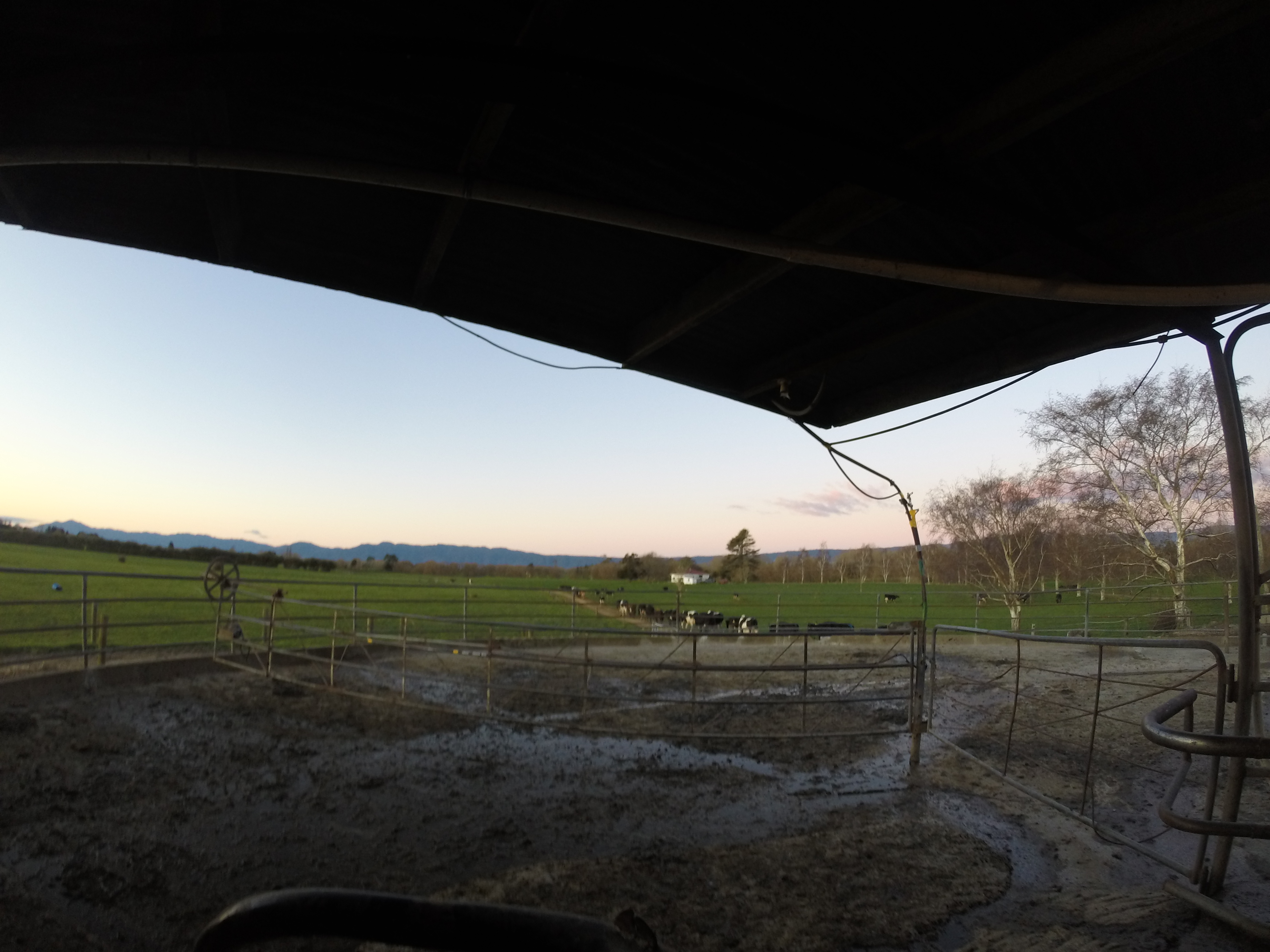
DCIM100GOPRO
After a victorious milking.

I can’t believe I wanted to leave this place just a few days ago. I love being here. I did so much badass shit today. I drove a tractor down the highway with a full load of silage. I taught two newborn calves how to drink and fed eight buckets of milk to the heifer calves. I shoveled soiled sawdust from the calf pens into the bucket on the tractor and then changed to the forklift to dump the rubbish bins into the trash pile. I rode a two-wheeler around the farm and chased cows and set up temporary fences. I got poo flung in my eye. My finger was caught between a cow and a metal bar. A cow kicked my arm into a beam. A cow stood on my toes while I was wrestling her back through the gate with her head in my arms grimacing, “Fuck you, cunt,” through my teeth. I’m sore and I’m tired but I wouldn’t have it any other way.

This story isn’t over yet. I can’t just cut a story short because of a brief period of doubt. I have to see it through. It’s OK to be uneasy. It’s ok to have that feeling in the pit of your stomach that makes you want to move on and leave everything behind. I always want to travel and drift, but right now my place is here on the farm.

DCIM100GOPRO
At peace.

There is no right time to write. Everyday I become a new person. Sometimes I read back on what I wrote in my journal last year and I wonder how I ever thought these thoughts. I think that is the purpose of writing. To make yourself immortal for a day. Maybe there is no write time, it’s just right all the time.

My Stock Sense is Tingling

Everyday I learn a new trick to help me control the cows. My outstretched arm creates a magical barrier. My “hup” tells them to line up in the milking shed and a pat on the bum tells them to move up. The honk of the horn on the farm bike is a reminder that I’m in charge. It takes years to develop stockmanship, but sometimes it’s a simple matter of dropping into a full on sprint to get in front of her before she runs away.

The best way to learn anything is by messing up. If you want a cow to turn around, you can’t chase her down. I’ve tried zooming the two-wheeler between a couple of rouge cows and an electrified wire fence and ended up down in the mud with a bruised knee and a deflated ego. It’s much easier to jump the fence behind the cow and jump back over in front of her. Farmers would be great at track and field, if they ever had spare time.

I’ve learned that it’s better to let a few cows out of the paddock even if you only want one of them. But when I follow those guidelines during the next challenge, Digger tries to stop me before it’s too late. The rules are always changing.

Mate, it’s a mind fuck tryin’ to get inside the mind of a cow,” he said after we won a short victory over the mob.

We are three weeks into the calving season now, with anywhere from one to six fresh ones dropping every day. Digger and I have worked out a routine. Well, an outline of a routine that constantly changes according to what has gone wrong that morning. Every afternoon we have to gather the new-born calves from the paddock and bring their mothers to the shed for milking.

Umm, can I take your baby, please?

He’s been in charge of this farm for a little over two months and he is already well-acquainted with the troublemakers. He can easily recognize the brash cows who aren’t afraid of using their massive bodies to break the gate that’s been welded together three times and who will jump a fence even if they know they will get shocked.

Sixty-one there, she’s a bitch. A real slut cunt,” Digger says as we walk into the paddock.

Some cows come easily, while some put up a struggle. It’s all about their age.

The heifers, young female cows that haven’t calved yet, are the equivalent of 18-year-old girls, he says. They don’t really have a motherly instinct yet; they only care about themselves. Yesterday we couldn’t get a heifer to follow her calf so we had to chase her around until she was tired enough to walk out on her own, with the dignity of a free, independent woman. The older cows are much more likely to follow their babies out of the paddock and generally be cooperative. They have been doing this song-and-dance for a few years now and they don’t put up a fight.

They are also the ones who stop to moo and moan to their young when we take them up to the shed for milking. They just want to cuddle their babies but we force suction cups on their udders twice a day for eight months instead.

Interacting positively with the calves is very important. Teaching them to drink milk is a practice in patience, you can’t force them. A rough, short-tempered farmer can change a young cow’s perspective on humans forever.  It doesn’t matter how you treat the bobby calves though. The males are loaded up into the bobby truck after three to four days. They are usually ground up for dog food or turned into a delicious veal steak.

Caption!
Moving a healthy heifer calf into a new pen.

It’s important to not fall in love with the animals. They are money makers, not pets. Especially when you are out to collect the calves and you find two dead being licked by their mums. They are called slinks, the still born. It’s an eery feeling dragging a rigid, cold calf out of the trailer on a dark night. It’s almost as disgusting as picking up afterbirth. Fortunately, the slimy blobs of blood and fat stick together surprisingly well.

I have learned a lot from Digger over the past six weeks, but there is no better teacher than being alone with the cows. Some days I have to bring the milkers to the shed by myself. First, I make sure the series of gates are in the right position before I let them out of their paddock. Then, I ride the two-wheeler down and let them out then slowly follow them, encourage the mob toward the milking shed.

Once they are in the yard, I have to make them line up probably in the shed, while keeping them calm. Cows can sense your temperament just as you can sense theirs. If their farmer yells and pushes aggressively, they will balk at your commands. You have to ask nicely and look at it from the cow’s perspective. At one point, I wanted to send three cows back into the yard and bring in three good milkers, that didn’t have any udder infections.

Cows don’t understand that their heads are attached to their bodies,” Digger’s words echo in my mind.

To turn a cow around, you can’t just push their bodies, they are way too big and they don’t care about you unless they can see you. I climbed around and pushed their noses back. It worked. They got the message and I felt like a cow champion with all the girls lined up nicely with no trouble when Digger came back to inspect my work.

I’m only here for a few months so I’m not going to pretend I’m a hardcore farmer who knows everything, but I’m learning the basics and getting by. I have also gained a new respect for real farmers. Just last night the outlook for dairy prices dropped again. New Zealand dairy farmers are enduring rainy days of frustration and agony, and the vast majority won’t even turn a profit this year. I have never met a group of people so dedicated to their lifestyle. Respect.

The Untouched Homeland

I feel extremely lucky to be from the United States. No, I don’t think it is the best country in the world. There is alarmingly high income inequality. Racism is ingrained into the social and economic system. There are regular mass shootings. Health care is privatized. Corporations are people. Money is speech.

I feel lucky to be an American because I can travel around America whenever I want. No visa required. I can stay there for as long as I want and do whatever I want. It’s so exciting.

Before I started traveling, I thought everyone hated America and Americans. After 13.5 months of meeting people from all over the world, working behind bars and espresso machines, living in hostels and flats and staying at friendly houses, I’ve realized it’s quite the opposite.

Everyone wants to go to America. People from all over the world have watched American movies their entire lives and they want to see Times Square, Hollywood, Las Vegas. They ask me if I’ve seen any movie stars and do I own any guns. Then they tell me about their aunt or brother or step-father who lived in Chicago for five years or they want to talk about how dangerous it is but it’s OK because they could easily disarm a man with a gun.

Usually if an older Australian or New Zealander has traveled to America, they do it big. They are the grey nomads who roam the world after retirement. They tell me they rented a camper van and traveled from Washington to Nevada to North Dakota to Louisiana to Virginia to Maine. They comment on how very few Americans travel, even to their neighboring states. Sadly, I’m guilty. Tennessee and Kentucky are adjacent to Virginia, but I’ve never been. These nomads remind of how little I have seen of my country.

Caravan park full of old people in Port Vincent, near Adelaide.

I’ve traveled all over the East Coast. Family in the North East, ex-girlfriend went to Clemson University in South Carolina, and my grandparents — of course — have a condo in Florida. I’ve visited some family in Oregon and took a trip to California after my little sister was Miss Virginia and we had to go to the nationals. I’ve skipped over the entire middle area. There is so much land there. I need to see what that’s all about. I feel like it is a foreign country.

I’m lucky because traveling and working in America is very hard if you don’t have a US passport. The United States only has reciprocal working holiday agreements with five countries: Australia, New Zealand, Ireland, Singapore and South Korea. That’s a lot less than most other developed nations.

Last night I talked to Hannah, a German girl who just came over to New Zealand after her Australian working holiday visa ended. She made me realize that travelers who want to work and holiday in America have to get creative. Hannah is looking into working as a summer camp counselor. There are programs that hire foreigners for three months to play team building games with little American boys and girls. The summer camp organizations apply for the work visa, pay for flights and accommodation and include three weeks of free travel time. These opportunities, however, are much more complicated than applying for a working holiday visa and hearing back in three days.

Europeans like Hannah have the benefit of easily traveling around the Eurozone, but there are 50 unique mini-countries I can choose from. The only downside is that Americans inhabit all of them.

Working in hospitality in a tourist town in Australia has taught me that Americans are by far the worst customers. They come in busloads to see Uluru and I can spot the yanks from a mile away. It’s the pure white New Balance tennis shoes purchased the day before the flight, the mispronunciation of Melbourne, and the general disregard for manners. Stereotypes are dangerous — there are plenty of considerate Americans — but this one is usually true.

They think because their tour includes a free breakfast, they can blow right past the “Please Wait to be Seated” sign and somehow completely ignore the guy standing behind the desk asking for their room number.

As soon as I started to criticize American tourists, my co-workers suddenly realized they can speak freely.

Why don’t they ever say thank you?” Sonny, my manager, would say.

“They think they own the world,” said Maureen, the morning supervisor.

The problem is simple. Americans are used to their waiters and bartenders being forced to either give good service or go home empty handed. The two dollars an hour they earn in their fortnightly paycheck is a pittance. If they forgot to bring that bottle of ketchup table eight requested 15 minutes ago, they just lost money.

Meanwhile, here I am staring at my phone behind a pool-side cafe in Australia, getting paid $24.60 AUD ($17.97 USD) an hour regardless of whether if I serve one cappuccino or 20 cocktails. If I’m slightly rude or inattentive to the occasional customer, my paycheck doesn’t change. The American tipping system, however, forces the waiters and bartenders to resent their co-workers and teaches the customer that they are the center of the universe. It’s capitalism at its finest. They have been trained to think they are entitled to everything and if something is different from the way it is back home, they don’t like it.

Umm, excuse me, what kind of bacon is this?” It’s the kind of bacon that won’t cause you to have a premature heart attack. It’s what the rest of the world eats.

Americans don’t like none of that fancy espresso coffee either.

“I just want a regular cup of coffee!” No worries, sounds like you want a long black. No? You just want a regular black coffee? Uhh, all we have is espresso. Can I please just make you a flat white? You’re not at the Waffle House, try something new.

11257809_1586823738261492_1200965114_n
Leigh holding the last cup of coffee I made in Australia.

They are loud and they have no self-awareness. There was an American woman with a slight southern accent who barged into the restaurant to refill her water bottle during the lull between brekkie and lunch. The general manager was having an important meeting with a client near the bar where I was polishing water glasses in silence.

“You don’t look Australian! Where are you from?” she asks Rena, the unsmiling, overworked and under-appreciated morning chef in the open kitchen. We can’t hear her response from the other side of the restaurant — I assume she said Sri Lanka — but everyone is taken aback by the loud American.

How’d’ya end up here?” she asks. This became my go-to annoying American tourist impersonation phrase.

It is certainly not the Americans I’ve met abroad who have changed my mind about the untouched homeland, it’s everyone else I’ve met along the way. It’s the adventurous Aussies, the curious Kiwis, the happy-go-lucky European backpackers on a gap year, the incredibly brave Asian travelers a who barely speak english: They all tell me they want to go to America. If everyone else wants to see this country I grew up in, shouldn’t I?

I would have never viewed America as such a diverse land with amazing landmarks and opportunities if I never left. I’ll just have to make it my mission to find the state with the least annoying people.

Road Magic

Are people always kind to travelers? Or are travelers always kind and people reciprocate?

I drove 30 kilometers south to Putaruru to get copies of my passport notarized for my Medicare exemption form so I can, hopefully, get some extra money back on my Australian tax return. I walked into the law office of Tim Kinder. The receptionist wasn’t at the front desk but a middle aged man wearing a beige sweater vest was toying with the photocopier.

“Hello, I need to get some documents notarized.”

“Oh, ok, I’m the notary, come on back to my office.”

I love small towns. Everything is easy. No one is in a rush. It’s not like the bustling suburbs of Northern Virginia where a five mile drive consists of 10 traffic lights, high school traffic, university traffic, city traffic, all kinds of traffic. And then you would wait in the office for 20 minutes.

A Boston cream donut and a cup of black coffee were waiting on his desk.

“Ahh, my assistant was nice to me this morning.”

I explain my situation as he examines my copies and my passport. He signs, stamps and presses his seal into the documents.

No charge for that one,” he says as we walk out of his office.

I was expecting at least a $20 fee but I guess his donut and coffee put him in a good mood. And I suppose his business does not rely on budget travelers looking for a notary in the middle of cow country.

Then there was the generous AA mechanic who fixed my van in Tauranga. He was toiling away in the shop at 8:30 on the night it broke down. He said he would look at it in the morning. I picked it up the next day around six. Same guy was there with the same sweaty hair and goatee.

“Another long day?” I say as I walk up to the reception desk.

“Yea, and tomorrow will be the same.”

He gave me his diagnosis. The van passed the compression tests, the TK tests and whatever other tests he put it through. Awesome. He replaced the thermostat, housing gasket and radiator hose. Air was getting into the radiator making steam, and heat.

“These old Mitsubishi’s don’t like heat.”

Another mechanic, wearing motorcycles leathers, walked by on his way out. He said he drove it down the expressway and back. Thermostat didn’t budge. They both trust it. But it is old. The sweaty mechanic said he knows this situation. You get a car fixed and think it’s great and then suddenly the head gasket blows and its a couple thousand dollars to fix. He’s been there before.

Look, this is a 700 dollar job. I found some cheap parts and worked it out for you. I’m gonna charge you 300 plus GST.”

After I paid up, he said to meet him at the garage around back. He gave me a 1.25 litre water bottle full of coolant.

“You’re a fucking legend,” I tell the fucking legend before I get in my van and listen to Dark Side of the Moon on the peaceful drive over the Kaimai’s with a cool engine.

I never had any drama with my 2000 Ford Falcon in Australia — except when I got stuck in sand one night just off the road and waved someone down for a quick tow — but I’ve heard a couple of amazing stories from backpackers.

Shit.
Shit.

Three german girls — Laila, Alex and Ari — drove an SUV with a mattress in the back from Sydney and almost made it to Alice Springs. They broke down on the Stuart Highway in the middle of nowhere. They didn’t have the $500 needed for a tow.

A true-blue stopped to help. He heard their situation and paid for the tow. Five hundred dollars to three strangers. This encouraged a fierce debate around the fire barrel at the hostel about how that would only happen to three beautiful girls. Damsels in distress.

No! He was just a nice guy, it wasn’t because we are girls!” Laila said, drawing eye rolls and suppressed chuckles from all the men.

I think Laila was right. When I was in Cairns I met three Belgian guys who broke down along the east coast. A tow truck was on the way. A friendly Australian mechanic happened to be driving by. He took a look at the car and got it going in a few minutes. They called off the tow and bought the mechanic a bottle of Bundy, an Australian rum. Before they parted ways he gave the boys his phone number and told them to call if they broke down again.

They drove for forty-five minutes the next day before the car died. True to his word, the mechanic drove out to them and fixed it up, this time for good. I have a theory that locals help travelers for selfish reasons. They know the broke and broken travelers will share their stories of generosity from hostel to hostel then back to Belgium and eventually the story of the nameless Australian mechanic ends up on a blog somewhere.

I try to give back to other travelers when I can. Ono hitch-hiked into Alice around 11 on a Thursday night. No accommodation booked, no familiar faces. The town was dead except for the Rock Bar and its bouncer standing guard. Ono asked the bouncer if he knew where he could stay for the night. He pointed to Kenny, an extremely Australian tour guide with a booming voice. Kenny approached Jeremy, maintenance worker at the hostel and my roommate, and asked if we can help a brother out. At this point Jeremy and I were sharing a six bed dorm. Four empty beds. We agreed to let this stranger into our room.

Ono is from Amsterdam but his parents are Indonesian. He speaks softly and is always smiling. In the pub full of drunk backpackers, I asked him what he does. He is a shamanist preacher. With a beer in my hand and a suitcase in his, he tried to explain the different planes of existence. I wasn’t getting it.

“Like, what do you do, man?” I ask.

I’ve been traveling for twenty years with no money.”

Imagine the generosity he has seen in those years. He told me about his time in Coober Pedy, the tiny mining town on the Stuart Highway. Josh and I drove straight through on our way down to Adelaide. Ono got a ride there from a local miner and stayed the night in his dugout. Most of the houses in Coober Pedy are dug into the sides of hills to take advantage of natural insulation to escape the 40 degree summer days with no humidity and no clouds. Ono met this man’s neighbors and friends and slept in his unique underground house. Some people spend thousands of dollars to travel around Australia dining at the finest restaurants, lodging at four star hotels, and here is Ono seeing a side of Australia they would never dream of.

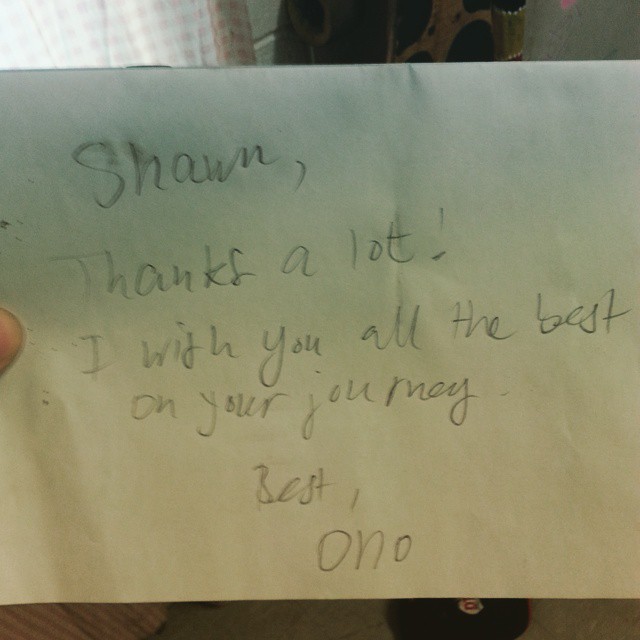
When I asked about his plans, he said he wants to hitch-hike to Uluru because he feels an overwhelming need to perform a shamanist ceremony near the sacred rock. I guess he found a ride because when I woke up the next morning he was gone, leaving only a note:

11357497_957560447639871_1890553206_n
I forgive you for misspelling my name.

I love meeting people like Ono. He presents himself and people give him food and shelter. He gives them his company, his stories and his advice.

Travelers like Ono understand that if you are kind to everyone, everyone will be kind to you. Fast food workers, lawyers, preachers, hotel housekeepers, mechanics — it doesn’t matter. We can all learn, share and grow with each other. We are all just people.